
Details
Real-Time $CO_2$ & VOC IAQ Monitoring: 2026 Systems Engineering
In the 2026 Malaysian mechanical sector, Real-Time Carbon Dioxide ($CO_2$) and Volatile Organic Compound (VOC) Monitoring has evolved from an optional environmental dashboard into a core engineering requirement. Driven by the Energy Efficiency and Conservation Act (EECA) 2024 (fully enforced since January 2025) and the DOSH 2026 Industrial Code of Practice on Indoor Air Quality, commercial building operators can no longer manage ventilation using static, fixed schedules.
Relying on constant, unmodulated fresh air intake introduces immense latent heat into the building envelope, spiking Building Energy Intensity (BEI). Conversely, restricting fresh air to save energy leads to the rapid buildup of human bioeffluents and chemical contaminants, violating Department of Occupational Safety and Health (DOSH) regulations.
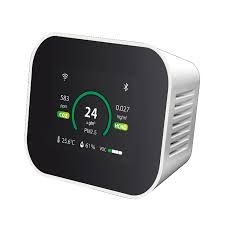
At EKG (Malaysia) SDN BHD, we engineer multi-parameter digital sensor networks that treat $CO_2$ and VOCs as dynamic inputs, allowing the air handling system to "breathe" in direct alignment with true occupancy demand.
1. The Sensor Core: NDIR vs. Metal-Oxide Semiconductor
To provide an audit-proof data trail for a Registered Energy Manager (REM) submission, sensor networks must separate human-sourced gases from building-sourced chemical compounds.
A. Carbon Dioxide ($CO_2$) Monitoring: Dual-Beam NDIR
Humans are the primary source of indoor carbon dioxide. To monitor this occupancy proxy without falling victim to the sensor drift caused by Malaysia's persistent ambient humidity ($>90\%$ RH), we utilize Dual-Beam Non-Dispersive Infrared (NDIR) sensors.
-
The Physics: An infrared diode directs light through an internal gas chamber across a specific absorption wavelength ($\approx 4.26\ \mu\text{m}$).
-
The Dual-Beam Stability: A primary optical receiver measures the light attenuation caused by passing $CO_2$ molecules. A secondary receiver acts as a shielded reference baseline. By comparing the two signals, the sensor automatically filters out light source aging and moisture interference, maintaining an accuracy of $\pm30\text{ ppm}$ over years of continuous operation.
B. Volatile Organic Compounds (VOCs): Broad-Spectrum MOS
While $CO_2$ tracks human presence, it cannot detect structural off-gassing from carpets, new furniture, paints, adhesives, or chemical cleaning agents. These are tracked via Metal-Oxide Semiconductor (MOS) multi-gas elements.
-
The Physics: The sensor chip features a heated metal-oxide layer (typically $\text{SnO}_2$) exposed to ambient air. In clean air, oxygen molecules adsorb onto the semiconductor surface, trapping electrons and establishing a high baseline electrical resistance.
-
The Sensing Event: When reducing gases (such as formaldehyde, benzene, toluene, or alcohols) hit the heated surface, they react with the adsorbed oxygen, releasing electrons back into the semiconductor matrix. This sudden drop in electrical resistance is converted by the internal microprocessor into a Total VOC (TVOC) equivalent value ($\text{ppm}$ or $\text{mg/m}^3$).
2. Dynamic Automation Architecture: Driving the HVAC Loop
Integrating real-time $CO_2$ and VOC transmitters transforms an isolated AHU Box into a responsive, demand-controlled node within a Connected HVAC System.
   [Breathing Zone Sensors] ----(BACnet MS/TP)----> [Central BMS Engine]
    (Real-Time CO2 & TVOC)                                   |
                                                    (Direct Digital Control)
                                                             |
                                                             v
[Outdoor Air Damper Actuator] <--- Modulate Dampers --- [IE5 EC Fan Speed Inverter]
   (Fresh Air Vol Managed)                                (Cube Law Energy Savings)
A. The Demand-Controlled Ventilation (DCV) Sequence
-
Data Ingestion: Zone sensors located in breathing paths stream localized air metrics to the central Building Management System (BMS) over a digital BACnet MS/TP or Modbus RTU network, bypassing the electrical signal noise generated by nearby power electronics.
-
Damper Modulation: If a conference room or office floor is occupied, the rising $CO_2$ or VOC concentration triggers the motorized fresh air intake dampers to modulate open, satisfying the ventilation rates mandated by ASHRAE 62.1 Compliant Airflow Monitoring.
-
Exploiting the Fan Cube Law: When spaces are empty, the dropping gas metrics command the Variable Speed Direct-Drive Plug Fans or IE5 EC FanWall Arrays to ramp down to an "Eco-Flush" baseline. Because fan shaft power is proportional to the cube of its speed ($P \propto n^3$), dropping the airflow velocity by just 20% reduces the fan's electrical consumption by roughly 50%, immediately dropping the asset's BEI score.
B. Resolving the VOC Override Conflict
Standard $CO_2$-only DCV networks suffer from a fatal flaw: if an office is empty, the system stops bringing in fresh air. However, building materials continue to emit chemicals, leading to a massive buildup of toxic compounds by Monday morning.
Our dual-parameter control logic solves this by maintaining an "Air Quality Highest-Wins" priority matrix. Even if $CO_2$ levels are low (indicating zero occupancy), a spike in TVOC levels from cleaning crews or carpet off-gassing will override the energy-saving mode, opening fresh air dampers to flush the floor clean.
3. Statutory Benchmarks: 2026 Malaysian Frameworks
To maintain a compliant operational status under current Energy Commission (ST) and DOSH audit frameworks, air metrics must be held within tight parameters:
| IAQ Parameter | DOSH 2026 Legal Maximum | EKG Grade-A Target | Engineering / Compliance Impact |
| Carbon Dioxide ($CO_2$) | $1,000\text{ ppm}$ | $< 800\text{ ppm}$ | Eliminates employee lethargy, improves cognitive function, and proves fresh air compliance. |
| Total VOCs (TVOC) | $3.0\text{ ppm}$ | $< 1.0\text{ ppm}$ | Eradicates "Sick Building Syndrome" symptoms and tenant liability risks. |
| Formaldehyde ($CH_2O$) | $0.1\text{ ppm}$ | $< 0.03\text{ ppm}$ | Highly critical for newly renovated spaces or retrofitted corporate layouts. |
| Specific Fan Power (SFP) | $\leq 1.1\text{ kW/m}^3\text{/s}$ | $0.6 - 1.0\text{ kW/m}^3\text{/s}$ | Enforced by EECA 2024; lower SFP registers a premium Building Energy Label. |
4. Mitigating Mechanical Liabilities: Casing and Insulation
Precision optical and chemical sensors will register severe false readings if the physical container housing the airflow suffers from structural neglect. During system retrofits, our teams address two primary physical issues:
-
Neutralizing "The Sponge Effect": Managing variable outdoor air loads in Malaysia means handling high humidity. If moisture carryover spills off the cooling coil and hits old internal fiberglass insulation, the material traps water like a sponge. This soggy layer acts as a breeding ground for biological VOCs (mold spores and mycotoxins) that bypass filters and contaminate the air stream. We strip out old fiberglass and replace it with Fiber-Free Closed-Cell Insulation, providing a smooth, hydrophobic internal skin.
-
Securing Casing Integrity (ATC 6 Class L1): Negative pressure zones inside the AHU can draw in unconditioned, humid, and dusty plant room air through leaky access doors or faulty frame seams. This air bypass distorts return air sensor metrics. We structurally reinforce the AHU Frame and panel joints to guarantee a highly sealed pressure containment vessel, ensuring that sensor feedback represents true building physics.
-
The BOMBA Life-Safety Interlock: Under BOMBA (JBPM) 2026 regulations, all energy-saving automation routines must feature a hardwired safety override. Upon receiving an emergency trigger from the Fire Alarm Monitoring System (FAMS), all smart sensor control paths are immediately bypassed to execute mandatory shutdown or smoke-spill ventilation protocols.
5. Financial Drivers: 100% GITA and Asset Performance
-
100% GITA Capital Asset Eligibility: Upgrading an office building or industrial plant with digital $CO_2$ and VOC monitoring networks linked to automated DCV infrastructure is a recognized energy-efficiency intervention. The complete hardware, installation, and software programming cost qualifies for the 100% Green Investment Tax Allowance (GITA), allowing the capital expense to be offset directly against corporate tax liabilities.
-
Avoiding Statutory Penalties: Providing an auditable, cloud-logged data trail via your AHU Energy Metering platform shields building owners from statutory fines (up to RM100,000) associated with non-compliance under the EECA 2024 energy benchmarks.
Are your facility's ventilation systems operating on blind, fixed-speed timers that waste energy on empty floors, or are you ready to transition to a high-performance 2026 demand-responsive platform?
View more about Real-time CO2 & VOC IAQ Monitoring on main site