
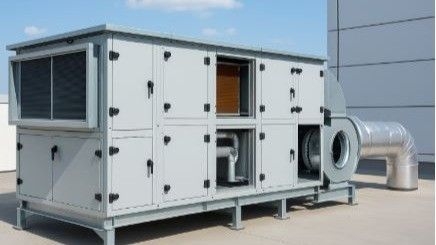
Demand Controlled Ventilation (DCV) Integration
Specifications
Details
Demand-Controlled Ventilation (DCV) Integration: 2026 Engineering Standards
In the 2026 Malaysian engineering landscape, Demand-Controlled Ventilation (DCV) has evolved from an optional "green" feature into a mandatory technical strategy for high-performance buildings.
At EKG (Malaysia) SDN BHD, we integrate DCV systems that ensure your facility remains Statutory-Compliant while achieving significant exponential energy savings.
1. The Statutory Mandate: DOSH 2026 & EECA 2024
As of 2026, DCV is a primary compliance tool for building owners in the Klang Valley to avoid statutory fines (up to RM100,000) for energy or air quality violations.
-
DOSH 1,000 ppm Ceiling: Under the DOSH 2026 guidelines,
$CO_2$ is the primary proxy for human-generated pollutants. DCV systems must be programmed to ensure indoor $CO_2$ concentrations never exceed 1,000 ppm. -
Building Energy Intensity (BEI): The
EECA 2024 requires buildings exceeding energy th resholds to implement an Energy Management System (EnMS). DCV is the most effective "Energy Conservation Measure" for reducing an AHU’s electrical footprint. -
GITA Asset Tier 1: Implementation of automated DCV is a high-priority category for the 100% Green Investment Tax Allowance (GITA), provided the energy savings are digitally documented.
2. Core Components of a 2026 DCV Integration
A professional DCV setup involves three critical layers of technology working in a synchronized loop:
| Component | 2026 Technical Standard | Engineering Purpose |
| Occupancy Sensors | NDIR $CO_2$ / VOC / PIR | Detects real-time occupant density and chemical pollutants. |
| Variable Speed Drive | IE5 EC Fan / VFD | Receives signals to modulate fan speed based on sensor data. |
| Control Logic | BACnet / Modbus TCP | Communicates with the BMS to maintain the 1,000 ppm threshold. |
| Damper Actuators | High-Torque Motorized | Modulates the intake of fresh air to match actual demand. |
3. The "Cube Law" Energy Advantage
The physics of DCV integration is anchored by the Affinity Laws (The Cube Law).
-
20% Speed Reduction: Results in approximately
50% Energy Savings. -
50% Speed Reduction: Results in nearly 87% Energy Savings.
By using DCV to slow the IE5 EC
4. Placement & Calibration: The 2026 "Breathing Zone"
Per MS 1525:2024 and DOSH standards, sensor placement is critical for statutory accuracy:
-
Breathing Zone: Sensors must be installed at
a height of 0.9m to 1.8m above the floor—where occupants actually breathe—not just in the return air duct. -
Avoidance Zones: Sensors must be placed away from supply air vents to prevent "false clean" readings caused by fresh air dilution.
-
Minimum Flush Rate: Even at zero occupancy, the DCV system must maintain a minimum "base" ventilation rate to remove building-source pollutants (VOCs) from carpets and furniture.
-
Neutralizing "The Sponge Effect": By modulating airflow precisely, we prevent moisture carryover into our Fiber-Free Closed-Cell Insulation, preserving the unit's thermal health.
5. Why Partner with EKG (Malaysia) SDN BHD?
We are installation and T&C specialists who bridge the gap between mechanical hardware and digital analytics.
Is your facility currently wasting energy by "over-ventilating" empty floors, or are you ready to transition to a high-performance 2026 DCV platform?
What is the specific occupancy pattern of your most energy-intensive space (e.g., a constant-flow open office vs. a fluctuating meeting room)?
View more about Demand Controlled Ventilation (DCV) Integration on main site