
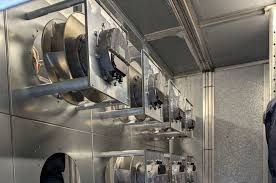
MS 1525 - 2024 Energy Efficient Air Paths
Specifications
Details
As of 2026, MS 1525:2024 (the latest revision of the Malaysian Standard for Energy Efficiency and Renewable Energy in Non-Residential Buildings) has introduced more stringent requirements for Energy Efficient Air Paths. These standards are designed to work in tandem with the Energy Efficiency and Conservation Act (EECA) 2024 to lower the Building Energy Index (BEI) across Malaysia.
In this regulatory landscape, "Air Paths" are no longer just about moving air; they are treated as pressure vessels that must minimize friction and leakage to reduce fan energy consumption.
1. Specific Fan Power (SFP) Limits
The cornerstone of air path efficiency in the 2024 update is the cap on Specific Fan Power (SFP).
-
Statutory Limit: The maximum allowable SFP for centralized systems is 1.6 kW/m³/s (or roughly 1.6 W per L/s).
-
The "Cube Law" Principle: Because fan power is proportional to the cube of the fan speed (
$P \propto n^3$), even a minor reduction in air path resistance allows the VFD (Variable Frequency Drive) to run at lower RPMs, resulting in exponential energy savings.
2. Aerodynamic Ducting & Fittings
To meet the 1.6 kW/m³/s limit, air paths must prioritize laminar flow over turbulent flow. MS 1525:2024 discourages high-resistance fittings that create "System Effect" losses.
-
Radius-Guided Bends: Standard mitered elbows (sharp 90° turns) are being phased out in favor of Radius-Guided Terminal Bends with a centerline radius of at least 1.5 times the duct width.
-
Expansion Transitions: Transitions between the AHU outlet and the main duct must have a gradual slope (typically 15° to 30°) to convert high-velocity pressure into static pressure efficiently.
-
SMACNA Seal Class A: All joints must meet the highest leakage standards. Under the EECA 2024, air leaking into a ceiling void is legally categorized as "Energy Waste."
3. Demand-Controlled Ventilation (DCV) Air Paths
The 2024 standards move away from "Constant Volume" air paths.
-
NDIR CO2 Sensor Integration: Sensors located in the return air path monitor CO2 levels. If levels are below 1,000 ppm, the air path modulates its dampers and fan speed to reduce outdoor air intake.
-
Low-Resistance Control Dampers: Modern motorized dampers are designed with aerofoil blades to ensure that even when partially closed, they do not create unnecessary pressure spikes that the VFD must fight.
4. Pressure Sensing & VFD Optimization
The "path" is now a feedback loop. MS 1525:2024 emphasizes the placement of Static Pressure Transducers.
-
Strategic Placement: Sensors are typically placed at the 2/3rd distance of the longest duct run. This ensures the VFD only provides the exact pressure needed to reach the furthest terminal, rather than "over-pressurizing" the entire path.
-
Static Pressure Reset: Smart BMS (Building Management Systems) now utilize "Static Pressure Reset" logic, where the setpoint is dynamically lowered until at least one VAV (Variable Air Volume) damper is fully open, ensuring the fan operates at its lowest possible power point.
5. Summary of Air Path Statutory Targets
| Component | MS 1525:2024 / EECA Requirement | Target Outcome |
| Max SFP | 1.6 kW/m³/s | Lower BEI Score |
| Leakage | Seal Class A | No "Spent" energy in ceiling voids |
| Bends | 1.5 Centerline Radius | Minimized Static Pressure |
| Filtration | Low-Pressure Drop (Merv 13+) | Reduced Fan Motor Load |
| IAQ | < 1,000 ppm CO2 | Compliance with DOSH (JKKP) |
Is your AHU system still using legacy "Constant Volume" air paths that risk failing 2026 energy audits? Contact EKG (Malaysia) SDN BHD today for a specialized Air Path & Aerodynamic Efficiency Audit.
View more about MS 1525 - 2024 Energy Efficient Air Paths on main site