
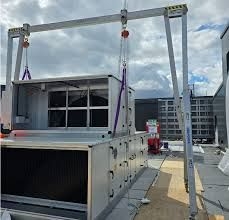
Heavy-Lift AHU Management for KL High-Rises
Specifications
Details
Heavy-Lift AHU Management for KL High-Rises
In the high-density urban environment of Kuala Lumpur, Heavy-Lift AHU Management for skyscrapers is a high-precision engineering operation.
At EKG (Malaysia) SDN BHD, we manage the entire heavy-lift lifecycle—from 4D lift simulations to final position validation—ensuring your assets are delivered Sterile, Silent, and Statutory-Compliant.
1. Statutory Compliance: The 2026 Certificate of Fitness (CF)
Following the full transition from the old PMA system on June 1, 2024, all lifting operations in Malaysia must comply with the new Certificate of Fitness (CF) framework.
-
15-Month CF Validity: Every crane and lifting appliance used in your project must have a valid CF issued within the last 15 months via the MyKKP portal. There is no grace period; expired certification leads to immediate site shut-down and penalties of up to RM 100,000.
-
Proof Load Testing: For 2026 high-rise projects, DOSH requires a static proof load test of 125% of the Safe Working Load (SWL) for new equipment and up to 125% for renewals, held for a minimum of 10 minutes with zero drift.
-
Competent Personnel: Every heavy lift must be overseen by a DOSH-certified Lifting Supervisor, supported by a certified Signalman and Rigger.
2. Advanced Rigging for High-Rise Logistics
Skyscraper lifting presents unique aerodynamic challenges. A standard lift can easily compromise an AHU’s TB2 Thermal Break casing or internal IE5 EC Fan Walls if not managed correctly.
-
Spreader Beam Mandate: We utilize certified spreader beams to ensure all lifting forces are strictly vertical. This prevents the "Side-Crushing" of panels, which would cause air leakage—categorized as "Energy Theft" under the EECA 2024.
-
Tag Line Orientation: In KL’s "Wind Canyons," we utilize dual-point synthetic tag lines. This prevents the AHU from spinning or colliding with the glass facade of the high-rise during the transition to the rooftop.
-
4D Path-of-Entry (POE) Simulation: We utilize LOD 400 BIM data to simulate the unit's entry through service hatches or louvers. This identifies potential "clashes" with structural beams or other MEP services before the crane is mobilized.
3. The Heavy-Lift Engineering Protocol
| Stage | Requirement | Engineering Outcome |
| Ground Assessment | Mackintosh Probe / Slab Verification | Ensures crane outriggers are stable in dense urban KL soils. |
| Rigging Audit | Ultrasonic Joint Check | Confirms the unit's sectional joints remain airtight after the lift. |
| Positioning | Precision Laser Leveling | Achieves the mandatory 1:100 slope for Sterile Drainage. |
| Digital Handover | LOD 500 Digital Twin | Proof of "As-Installed" integrity for the 5-year periodic energy audit. |
4. Why Partner with EKG (Malaysia) SDN BHD?
-
Technical Integrity: We are mechanical engineers who understand the internal sensitivities of the high-efficiency assets we lift.
-
Urban Logistics Expertise: We manage all DBKL (Kuala Lumpur City Hall) and PDRM permits required for night-lifts or road closures in high-traffic zones.
-
GITA Support: Our documented lifting and positioning reports provide the technical proof required for your business to claim the 100% Green Investment Tax Allowance.
Is your heavy-lift project engineered for 2026 performance or is it a structural risk? Contact EKG (Malaysia) SDN BHD today for specialized Heavy-Lift AHU Management.
View more about Heavy-Lift AHU Management for KL High-Rises on main site