
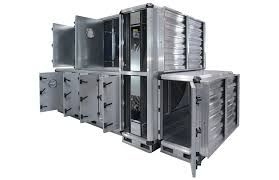
Details
The AHU landscape in 2026 is defined by a significant transition from "recommended guidelines" to "mandatory statutory requirements." In Malaysia, the primary shift is driven by the EECA 2024, which treats the Air Handling Unit as a compliance tool rather than just a cooling component.
1. The EECA 2024 Enforcement (Malaysia)
As of January 1, 2025, the Energy Efficiency and Conservation Act is active.
-
Mandatory BEI Star Ratings: Commercial buildings must now display an energy label.
An AHU that fails to meet high-efficiency benchmarks will likely cause a building to fall below the mandatory 2-star minimum, risking fines between RM 20,000 and RM 100,000. -
EnMS Requirements: Modern AHUs must now integrate into a formal Energy Management System (EnMS).
This means "standalone" AHUs without digital communication or demand-controlled sensors no longer meet the compliance standard for designated buildings.
2. MS 1525:2024 Technical Benchmarks
The updated Malaysian Standard MS 1525 has tightened the specific technical parameters for AHUs:
-
SFP (Specific Fan Power): The standard pushes for a limit of 1.6 kW per cubic meter per second. Design engineers are now prioritizing IE5 EC Plug Fans over belt-driven units to guarantee this efficiency.
-
Fan Arrays: There is a move away from single large fans toward fan walls. This provides redundancy (if one fan fails, the building stays pressurized) and allows the unit to operate at its Best Efficiency Point (BEP) across varying loads.
3. International Certification Updates (2025-2026)
Globally recognized bodies have released updated "Revision 2025/2026" rules for AHU certification:
-
Eurovent (ECP 05 Revision 2025): The new Eurovent rules focus more heavily on Real Unit Performance rather than just model box testing.
This ensures that the unit delivered to the site performs exactly as simulated in the software. -
AHRI 1350/1351: These standards have refined the classifications for Thermal Transmittance (TT) and Thermal Bridging (TBF). High-performance units must now consistently hit T2/TB2 ratings to be considered "Certified Energy Saving" in tropical, high-humidity climates like Malaysia.
4. Hygienic and Smart AHU Standards
-
Hygienic AHU (HAHU) Certification: There is a surge in demand for Eurovent-certified Hygienic AHUs beyond hospitals (e.g., in data centers and semiconductor plants) to prevent mold and ensure the highest indoor air quality.
-
Plug-and-Play Intelligence: Modern standards now favor "Smart AHUs" that come with factory-fitted controllers. These units are tested as a single assembly, ensuring the VFD, sensors, and fan motors are perfectly calibrated for energy recovery before leaving the factory.
Comparison: Legacy vs. 2026 Standard AHU
How would you like to apply these new standards to your current or upcoming projects?
View more about New AHU Standards on main site